What Is a Wrinkle & When Does It Become a Crease?

When does a wrinkle stop being a fine line and start becoming a crease? It’s a deceptively simple question, yet the answer reveals one of the most pivotal moments in the biology of aging skin. Because the shift from wrinkle to crease isn’t just cosmetic, it’s structural. Understanding this turning point is the key to knowing when and how to get rid of deep wrinkles before they become etched into the skin’s architecture.
At Perricone MD, we believe visible aging is not random. It follows a timeline—one defined by inflammation, cellular fatigue and a gradual breakdown in the skin’s ability to repair itself. And nowhere is that more evident than in the evolution from wrinkle to crease.
Wrinkles: Where Aging Begins
To understand creases, we must first understand the definition of ‘wrinkle’. In its earliest form, a wrinkle is a dynamic line. This temporary fold in the skin is created by repeated facial movements. Think of crow’s feet when you smile or faint lines across the forehead when you raise your eyebrows — these are not permanent; they appear with expression and fade at rest.
From a scientific standpoint, a wrinkle (at this stage) is a sign of dehydration, mild collagen decline and the skin responding normally to movement over time. Many people ask, when do wrinkles start? For most, it’s late 20s to early 30s, when collagen production naturally begins to slow down and environmental stressors accumulate.
At this point, the skin can still rebound because cellular turnover is more frequent and the skin’s repair mechanisms are functioning optimally. With proper hydration, sun protection and anti-inflammatory skincare, these early lines can remain fleeting.
But without intervention, biology takes a different turn.
From Dynamic to Static: When Wrinkles Deepen
As years pass, repeated facial movements collide with a slower repair cycle. The skin no longer “snaps back” as efficiently, collagen and elastin fibers weaken and neurochemical signaling between skin cells and nerves begins to decline. This is when wrinkles linger.
Over time, dehydration, UV exposure, oxidative stress and chronic low-grade inflammation accelerate this process. UV damage alone significantly depletes collagen and elastin reserves, while inflammation disrupts the skin’s ability to rebuild what’s been lost. Eventually, dynamic wrinkles become static wrinkles (those visible even when the face is at rest). These are no longer temporary lines, they are permanent impressions in the skin.
This is the moment many consumers begin searching for answers to questions like:
- What makes wrinkles worse
- How to get rid of deep wrinkles
- How to get rid of a crease in the forehead
And this is where the concept of a crease emerges.
Define Crease: A Structural Shift in Skin
So, what is a crease? A crease is a deep, static wrinkle caused by structural collapse within the dermis. Unlike fine lines, creases are wider, deeper and more etched. They form when the skin’s support network (collagen, elastin and extracellular matrix) can no longer withstand mechanical stress.
Common types include:
- Forehead creases
- Creases between eyebrows (often called frown lines or 11s)
- Creases under the eyes where the skin is thinner and more fragile
- Creases around the nose and mouth, including nasolabial folds and marionette lines
- Neck creases
At this stage, topical hydration alone is not enough. Creases represent a breakdown in communication between cells, nerves and the skin’s repair systems. This is where Dr. Perricone’s foundational philosophy becomes essential.
Creases are the visible proof of that breakdown.
Why Wrinkles Are Not All Treated the Same
One of the most misunderstood aspects of mature skincare is the assumption that all wrinkles respond to the same ingredients. They don’t.
Fine lines caused by dehydration require different strategies than deep creases formed by structural loss. Treating a crease in your forehead or between your eyebrows demands advanced actives and targeted delivery systems capable of working deeper within the skin.
This distinction is critical. Because when consumers ask how to get rid of deep wrinkles, the answer lies not in stronger exfoliation or surface-level plumping, but in restoring communication between your body and skin.
The Intelligent Solution: Neuropeptide Deep Crease Serum
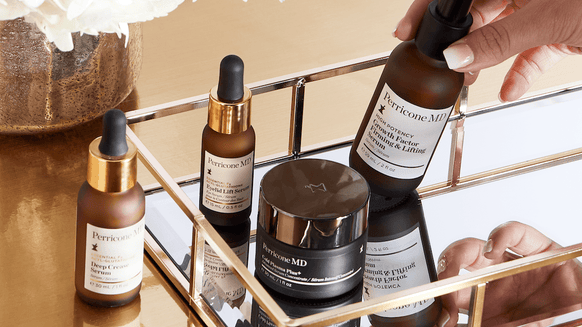
Neuropeptide Deep Crease Serum was engineered specifically for this turning point in aging, when wrinkles become creases and skin requires a more intelligent approach.
This highly potent, silky serum targets stubborn deep lines and creases so wrinkle depth appears shallower and the look of expression lines is reduced.
At the core of the formula are neuropeptides, intelligent messenger molecules to help promote visible skin renewal. As your body’s natural neuropeptide activity declines with age, your skin loses its ability to respond efficiently to repair signals. By replenishing this pathway, the skin becomes more resilient, elastic and dense over time.
Unlike aggressive wrinkle treatments, this Deep Crease Serum delivers high performance ingredients that are suitable for mature, thin or fragile skin. In a clinical study of 32 women after 8 weeks, 84% showed a significant reduction in lines. Meanwhile, a consumer study of 109 women after 28 days revealed that 84% said it improves skin density & smooths wrinkles and 83% felt firmer, tighter & lifted skin.
Rethinking Aging: Rewrite the Lines of Time
When we understand the biological difference between a wrinkle and a crease, we gain agency. We stop chasing surface fixes and begin addressing the real source of change.
A crease tells us when it’s time for smarter science. At Perricone MD, we believe this moment isn’t a setback; it’s an opportunity. An opportunity to intervene with innovation and proven science.
Because a wrinkle is just the beginning, a crease is where science steps in.